Hype in a Syringe
Salmon sperm, exosomes, PDGF—experts sound off on trending treatments in regenerative aesthetics

The modern-day version of hope in a jar? Hype in a syringe. Welcome to the world of regenerative aesthetics! Please excuse the chaos.
In aesthetics, regenerative therapies can generally be divided into two main categories: treatments derived directly from our own bodies (like fat grafting, nanofat, and PRP) and those made in a lab from exogenous cell components. Products in the latter camp—polynucleotides, exosomes, and PDGF (platelet-derived growth factor), for instance—tend to be more controversial than their autologous counterparts due to the overall uncertainty and variability of their sourcing, purity, processing, safety, and efficacy. Most are purported to improve skin quality (to thicken skin and give a glow); some aim to boost hair growth. On the skin front, especially, clinical evidence is lacking and treatments are commonly sold based on “game-changing” anecdotes.
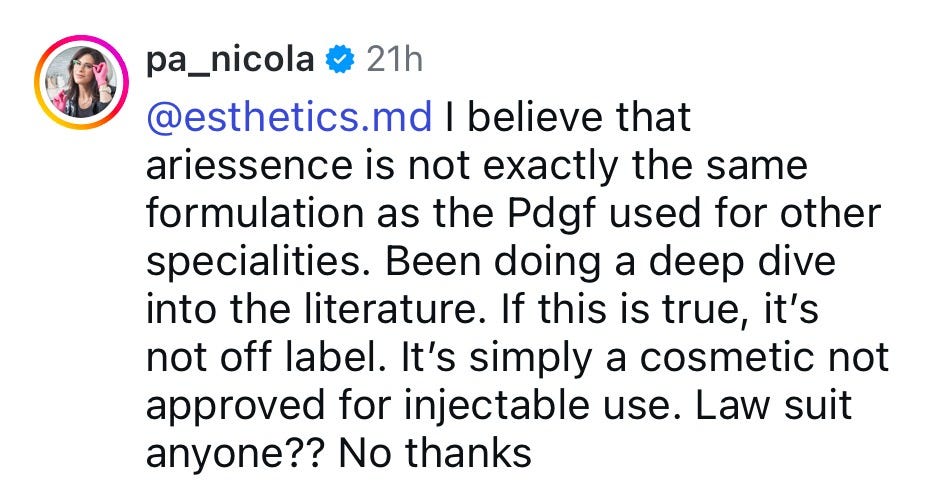
There’s also the matter of FDA approval. (The FDA’s Center for Biologics Evaluation and Research regulates blood-, tissue-, and cell-based products.) While this should be a fairly black-and-white issue, even legality is up for debate with some of these substances. Take PDGF: Practitioners endlessly quibble over its regulatory status. As I understand it, the FDA has approved certain PDGF formulations for specific medical indications outside of aesthetics, like periodontal defects and diabetic neuropathic ulcers. Some proponents of PDGF assert that since the FDA has approved these PDGF-based products, that using a similar formulation with the same core active for cosmetic purposes is merely an off-label application. And, Hey, we use Botox off-label all the time, they say.
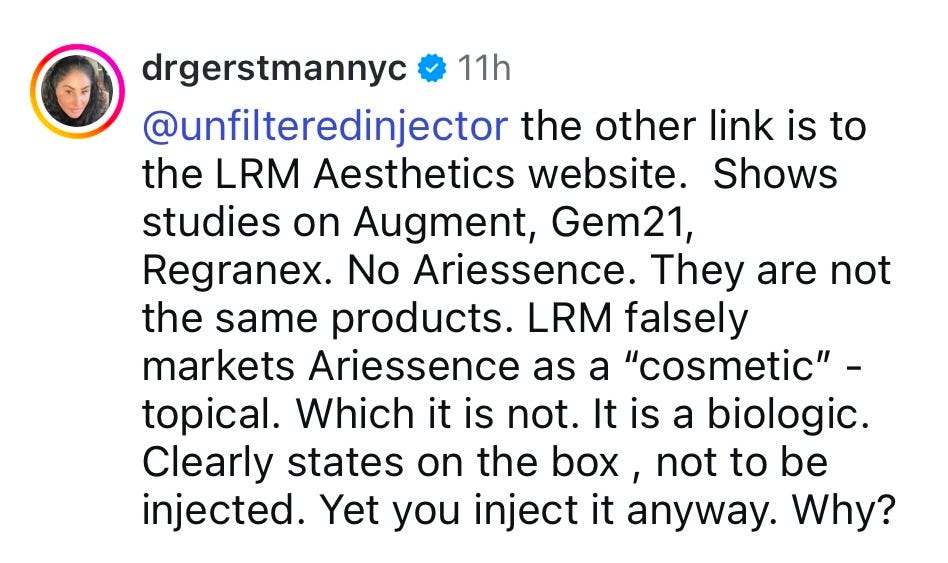
Critics argue that this extrapolation is unethical and illegal, because the precise product that aesthetics pros are injecting (mainly into tear troughs) is not an exact replica of the PDGF-containing formulation that is FDA approved for periodontal regeneration (which is, according to the package insert, “intended to be placed into periodontally related defects” and “must not be injected systemically”). Nor is the cosmetic version a carbon copy of the wound-healing topical that’s approved for treating diabetic ulcers. It’s also not identical to the iteration of PDGF that is an approved bone graft alternative. If the product being used to enhance skin and hair is not one of the same formulas that’s been reviewed and approved for other indications, then its use in aesthetics is technically illegal, not off-label, some experts maintain.